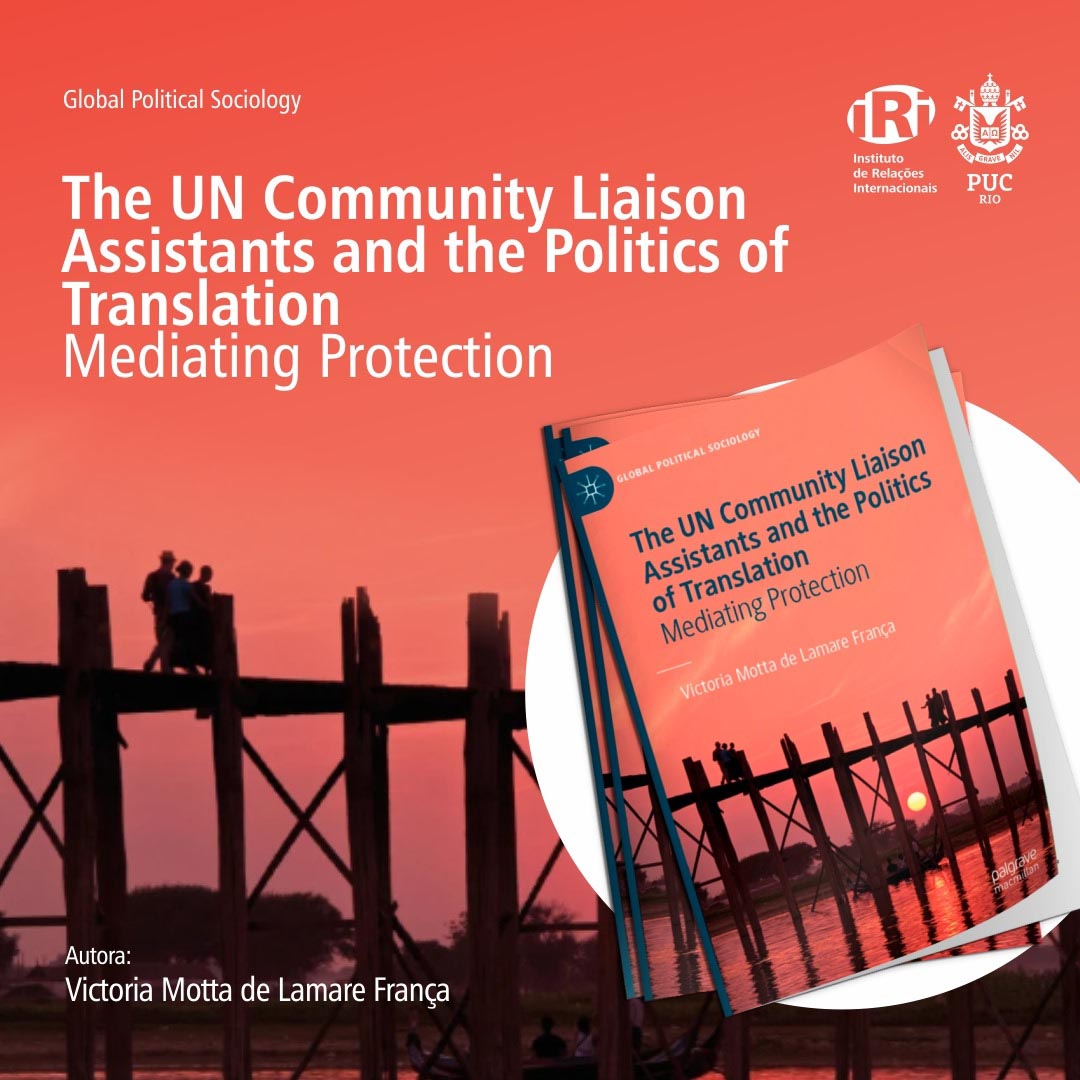
Mediating Protection? The UN Community Liaison Assistants and the Politics of Translation

Victória Motta Lamare França’s dissertation, defended at IRI in 2023, under the supervision of Professor Maíra Siman, and co-supervised by Professor Roberto Yamato, won the Best Dissertation award at the 12th ABRI National Competition for University Dissertations and Theses in International Relations, “Professor Marcos Costa Lima Award”.

The dissertation entitled Mediating Protection? The UN Community Liaison Assistants and the Politics of Translation was published in English in 2024 by Palgrave, in the collection Global Political Sociology:

The award-winning paper analyzes how the United Nations (UN) attempts to stabilize and justify an ambivalent meaning of protection and its socio-political roles in the Protection of Civilians (PoC) agenda. The research takes Community Liaison Assistants (CLAs) as an analytical prism to reflect on the instrumentalization of language and culture in UN peace operations.

From a post-structuralist and post-colonial approach, the research promotes dialogues with Translation and Interpretation Studies by exploring the political character of translation for International Relations while delving into an actor generally neglected in UN doctrine and Peace Operations Studies.
Internationalization as Practice: A Global South Perspective on the International Political Economy of Higher Education

How does a university become international? In this chapter, Associate Professor and Director of IRI/PUC-Rio Isabel Rocha de Siqueira and IRI/PUC-Rio PhD student Nycolas Candido discuss how the practice of institutes and departments impacts the concept of internationalization of higher education and its possible applications.

With a focus on the Global South, Candido and Siqueira analyze measures implemented at the IRI itself to learn about the international experience of its student body. Among the main conclusions, the chapter identifies that historical inequalities between the Global North and South are reinforced and reinvented by concrete modes of internationalization, which calls for a critical and multidimensional conceptualization of the term.

The chapter is part of the collection “Contemporary Approaches to Internationalization in Higher Education” which can be accessed at the link below:

From binary to intersectional to imbricated approaches: gender in a decolonial and diasporic perspective

This article proposes a re-reading of the problem of gender, or as it has been put, more often than not, ‘the woman problem,’ that resists the reproduction of modern/colonial systems of governance and their political norms, standards, ideals and pacts. In turn, it seeks to open pathways to dialogue with, rather than import, conceptions of gender that respond to the terms through which modern/colonial societies have been forged on the continent of Abya Yala, drawing inspiration from decolonial and diasporic perspectives. To this end, the article maps some of the available channels of the gender debate in what has come to be known as the global South from an array of perspectives that highlight the ways in which the relations between categories of oppression and privilege (such as race, class, sexuality and gender) are reflected and positioned so as to grapple with the coloniality of knowledge, power and being. More specifically, it focuses on three ways of dealing with power dynamics in the context of Abya Yala that have influenced how we conceive and respond to questions of gender. Its primary objective is to investigate the politico-epistemic conditions that structure gender thinking in binary and intersectional ways, and, in turn, open space for imbricated approaches forged from within (post-)colonial histories that do not take as their starting point the importation of theoretical references from places otherwise situated within a global political economy of knowledge/power/being. More than a critique of theoretical standpoints from the global North, in and of themselves, which regardless were not thought to respond to our realities, here we analyse the terms through which gender and feminisms have been put up for debate. Without effectively decentring the Eurocentred references that preoccupy gender thinking in our respective disputes, we risk continued distraction from what is at stake when gender is put on the table: the (im)possibilities of living one’s full humanity on one’s own terms.

Article published in the journal Contexto Internacional, special issue Gender in the Global South.

Authors: Andréa Gill and Thula Pires

Masculinities, Art and Peripheral Powers

What is the importance of discussing the concept of masculinities?

Over the last few decades, gender relations have been debated and deconstructed as a result of various feminist contributions. The theme of masculinities has become a crucial point of analysis and reflection: the (re)production of unequal gender norms and standards are, however, relational. In this sense, it is very important to talk about masculinities for feminist and gender studies themselves. After all, how to think about “women” without thinking about “men”, since these identities are relational and intertwined?

It is with this objective that we produced the booklet “Masculinities, Art and Peripheral Powers”. This document seeks to broaden the field of reflection on the subject from discussions that deal with the very concept of masculinity, deepening the understanding of markers of difference, such as what it means to “be a man”, of the processes of production of sexualities through sexual relations. socially imposed norms and standards and the role of art in the construction of other masculinities. Throughout the booklet, the various artistic initiatives that, together with the GlobalGRACE Brasil project team, seek to create new references for thinking about gender, masculinity and sexuality are presented. Thinking about the “I-Body”, and its intimate relationship with the territories, especially with the peripheral territory, suggests possible paths for a more equitable and healthy life in society for all people.

This document contains records of the works of artists who integrated the Brazilian actions of GlobalGRACE: Residência Masculinidades NoBela, Residência Passinho Carioca and ELÃ – Construindo Masculinidades Outros.

The booklet is available for free download in English, Spanish and Portuguese.

GlobalGRACE is a project funded by the Global Challenge Research Fund (GCRF/RCUK) that mobilizes artistic interventions to research and enable gender approaches that contribute to well-being internationally and that includes universities and NGOs from Bangladesh, Brazil, Mexico, the Philippines , South Africa and the United Kingdom. In Brazil, it has been developed by the Institute of International Relations at PUC-Rio and the NGOs Promundo, UNIperiferias and Observatório de Favelas, in partnership with CES/Universidade de Coimbra. See more about GlobalGRACE.

Post-conflict Colombia and the global circulation of military expertise

Professor Manuela Trindade Viana has just published the book “Post-conflict Colombia and the global circulation of military expertise” by Palgrave Macmillan. The work is part of the series “Critical Security Studies in the Global South”, edited by Profs. Pinar Bilgin (Bilkent University) and Monica Herz (IRI/PUC-Rio).

In the book, Manuela proposes that we think about the “post-conflict” not in terms of the presence/absence of violence, but of changes in the use of violence. Taking Colombia and its international circulation as a “successful case” as an entry point, the analysis unfolds in two parts. The first explores the conditions of possibility of this “success story” and the web of criteria that legitimize it, as well as the silencing mechanisms that allow Colombia to circulate internationally as a formula to be replicated in other parts of the world. The second focuses on the historicization of the mechanisms by which the new rules are transmitted among the professionals of the public force, especially the transformations of military schools and training centers in Colombia from the times of “war” to the times of “peace”. Manuela argues that the key to repositioning the country in the hemispheric and global circuit of military knowledge is a discursive articulation around the military professional who moves from the “soldier-citizen” to the “soldier-expert”.

The book’s preface is open access, as is the index – both available.

40 Years of Critical Theory on International Relations

By exploring metatheoretical and methodological debates, ethical questions, discussions on the geography of knowledge as well as empirical analyses starting form innovative theoretical frameworks, the articles in this dossier contribute, we hope, even in a small way to the relevance of critical theory in IR and, even more, to the imperative of a critical way of thinking the IR realm.

The new edition, entitled “40 Years Of Critical Theory on International Relations” can now be accessed and downloaded in full, with free access.

Table of contents

Contexto Internacional, Volume: 44, Issue: 1, Published: 2022

40 Years of Critical Theory on International Relations Ramos, LeonardoWorth, OwenVivares, Ernesto

Text: EN / PDF: EN

Building Bridges between Dependency Theory and Neo-Gramscian Critical Theory: The Agency-Structure Relation as a Starting Point Mello, Rafael Alexandre

Abstract: EN PT / Text: EN / PDF: EN

Bringing the Critical Thinking Back in: A Critique of Andrew Linklater’s Theoretical Contributions to International Relations Sander, Fabiana FreitasSouza, Matheus

Abstract: EN PT / Text: EN / PDF: EN

Is Critique Still Possible in International Relations Theory? A Critical Engagement with IR’s Vocation Souza, Natália Maria Félix de

Abstract: EN PT / Text: EN / PDF: EN

How Does Gramsci Travel in Latin America? Before and After Critical International Relations Theory Tussie, DianaRamos, Leonardo

Abstract: EN PT / Text: EN / PDF: EN

Land Grabbing and International Political Economy: Towards a Critical Neo-Gramscian Theoretical Model of Land Governance in Latin America Mora, Sol

Abstract: EN PT / Text: EN / PDF: EN

International Political Economy and Sustainable Finance: Assessing the EU’s Green Deal and UNCTAD’s Green New Deal Jäger, Johannes

Abstract: EN PT / Text: EN / PDF: EN

African regional integration: panorama, progress and challenges

Regionalism is the way in which nation-states seek to resolve political and economic issues at the regional level, traditionally
linked to the promotion of free trade and the overcoming of inter-state conflicts. For less developed countries, regionalism is
perceived as a strategic mechanism for development. In the face of the independence processes, African integration initiatives
began to be thought out and founded concomitantly with the formation of nation-states during the 20th century. This makes
the integration of the African continent a particular process. The present paper aims to make an analysis of the institutional
design and degree of institutionalization of the main African regional organizations, emphasizing their objectives and their
role for continental integration. Thus, it offers a history of the creation of integration mechanisms that culminated in the
formation of the African Union (AU), the continent’s main integration organization. It also addresses the institutionalization
of the two most recent major development mechanisms of the African Union, Agenda 2063 and the African Continental Free
Trade Area (AfCFTA). It, then, presents an institutional analysis of the eight regional economic communities (RECs) recognized
by the African Union, which work collaboratively with the organization to promote broad integration. Finally, a synthesis is
made with notes on the main difficulties, challenges and advances of this complex structure of regional integration.

Authors: Caroline Chagas de Assis, Renata Albuquerque Ribeiro e Ana Saggioro Garcia
Published on Boletim de economia e política internacional / Instituto de Pesquisa Econômica Aplicada (IPEA).

Participatory methodologies and caring about numbers in the 2030 Sustainable Development Goals Agenda

The article “Participatory methodologies and caring about numbers in the 2030 Sustainable Development Goals Agenda”, produced by professor Isabel Rocha de Siqueira and doctoral student Laís Ramalho, has just been published in the academic journal Policy and Society. Policy & Society is one of the leading publications currently in the study of theory and practice in the area of Political Science, IR and Public Policy, with a very high impact factor.

Abstract: Governing by indicators has emerged as the predominant mode of global public policy. Consequently, global governance has become a field in which different indicators compete for policymakers’ and public attention. This begs a question—what makes some indicators successful when others become irrelevant? This paper explores this problem through the inquiry into the measurement of multidimensional poverty in Sustainable Development Goal 1 (“End poverty in all its forms everywhere”). In the field historically dominated by the World Bank’s dollar-per-day metric (currently 1.9$), multidimensional poverty measurement gained prominence, becoming one of the key measures of global poverty. By tracking the pathways to success of multidimensional poverty measurement—through qualitative interviews with actors in International Organisations this paper argues that the key quality of successful indicators is their ability to become parts of the broader epistemic infrastructure, linking political institutions, actors (including experts and policymakers), and data and statistics. The paper brings the focus on a specific set of actors—statistical entrepreneurs—who advocate for innovations in measurement and work toward creating such infrastructures, thus indirectly promoting new policy ideas reflected in the metrics.

Civil-military relations as a ‘coordination problem’? doctrine development and the multiple ‘missions’ of the Brazilian Armed Forces

This article by authors Victória M. S. Santos and Maíra Siman was published in the prestigious international journal Critical Military Studies, by Editora Routledge, Taylor & Francis Group.

Abstract: As the Brazilian Armed Forces are increasingly deployed outside the realm of defence against external threats (in tasks such as peacekeeping, public security, and migration management), military doctrine on Civil-Military Coordination and Cooperation (CIMIC) has emerged as a body of ‘technical knowledge’ which would support their interactions with various civilian actors. This is expressed in frequent demands by military officers for the development of a ‘Brazilian CIMIC doctrine’ reflecting both the accumulated knowledge of international partners, such as NATO and the UN, and their own experience in the ‘field’, as in their recent engagement in the United Nations Stabilization Mission in Haiti (MINUSTAH). We argue that the progressive institutionalization of CIMIC military doctrine recently observed in the country reinforces a perspective according to which several domains of action traditionally attributed or led by civilian actors are seen as a legitimate part of the so-called ‘mission’ of the Brazilian Armed Forces. As a result, political disputes concerning civil-military relations and the role of military organizations outside the realm of external defence are reduced to technical challenges of coordination and cooperation between military officials, civilian state agencies and the Brazilian society. In this article, we discuss this trend by analysing the development of military doctrine on CIMIC within the Brazilian Army, and its connections with their increasing engagement in peacekeeping, public security, and migration management at home and abroad.

Economic relations between China, Latin America and the Caribbean: an analysis of international investment agreements

China plays a central role in the international investment regime as a investor and host country for foreign direct investment. It is also the first country with the largest number of bilateral investment treaties. In this paper, we analyze China’s treaties with Latin American and Caribbean countries and the main features of their trade, financial and investment relations. We seek to question to what extent China can become an alternative partner for the economies of the region and whether it contributes to promoting innovations in the current BIT model.

Authors: Ana Saggioro Garcia (IRI/PUC-Rio) & Rodrigo Curty (University of Waterloo)

Published on April 25, in Carta Internacional, a scientific journal of the Brazilian Association of International Relations.